
Power Production in the Space Economy: Research Publication
Fission Reactors, Advanced Solar Systems, and Laser Beaming Innovations for Sustained Extraterrestrial Operations
Executive Summary
In August 2025, NASA's Fission Surface Power directive allocated $350M toward 100+ kWe lunar reactor development, validating nuclear power as essential infrastructure for sustained extraterrestrial operations. This white paper examines five years of power technology maturation (2020–2025) across fission surface reactors, advanced solar architectures, and infrared laser beaming systems. As Artemis Base Camp targets early-2030s deployment and commercial platforms pursue in-situ resource utilization requiring 60–70 kW continuous loads, the analysis documents competing approaches to the foundational challenge of delivering reliable electricity through 354-hour lunar nights, -173°C to +127°C thermal extremes, and pervasive regolith dust. With fission reaching TRL 5–6, vertical solar arrays at TRL 6–8, and laser beaming demonstrations achieving 10–20% end-to-end efficiency, the 2026–2030 period represents a critical maturation window before operational deployment decisions.

Comprehensive analysis of power generation technologies for sustained extraterrestrial operations, examining NASA's Fission Surface Power initiative, vertical solar array prototypes, and infrared laser beaming systems across 2020-2025 development cycles. Documents validated outcomes including TRL 5-6 fission reactor designs achieving 150 kg/kWe specific mass, electrodynamic dust shields demonstrating 80-100% removal efficiency on Blue Ghost lunar mission, and 1.1 kW optical power transmission demonstrations. Delivers strategic frameworks for technology selection, hybrid grid integration, and regulatory pathway navigation. Serves engineers evaluating power system architectures and investors assessing infrastructure deployment opportunities in the $500M-$2B lunar power market.
Research Context: The Extraterrestrial Power Challenge
Terrestrial power infrastructure assumptions collapse in extraterrestrial environments. The lunar surface imposes constraints absent from orbital or Earth-based systems: 354-hour darkness periods at most latitudes eliminate solar generation for two-week intervals, regolith dust exhibiting electrostatic adhesion degrades photovoltaic efficiency by 40% under 2 mg/cm² accumulation, and temperature swings from -173°C to +127°C preclude convective cooling mechanisms that terrestrial and atmospheric systems rely upon.
This white paper examines technology development across three distinct power generation paradigms between 2020 and 2025: NASA's Fission Surface Power initiative targeting 40–100 kWe class reactors with high-assay low-enriched uranium fuel and Stirling conversion; Lockheed Martin and Astrobotic vertical solar array prototypes achieving 30–85 W/kg specific power with electrodynamic dust mitigation; and Star Catcher Industries' November 2025 demonstration of 1.1 kW optical power beaming to standard photovoltaic panels without custom receiver hardware.
Market projections indicate lunar power infrastructure scaling from initial 50–100 kW Artemis Base Camp deployments to multi-megawatt industrial capacity supporting propellant production and electromagnetic launch systems by 2035, representing a $500M–$2B addressable market at current $50–$200/W deployed cost structures. As commercial platforms prepare for 2028–2030 operational transitions and in-situ resource utilization facilities demand continuous 60–70 kW electrical loads for oxygen extraction via ilmenite reduction, the convergence of validated technology demonstrations with government anchor procurement creates strategic positioning windows for power-as-a-service business models and hybrid grid integration.
Validated Outcomes Across Three Power Generation Domains
Fission Surface Power Systems
NASA's Fission Surface Power initiative achieved critical validation milestones through Phase 1 contractor studies completed in 2023 by Lockheed Martin/BWXT, Westinghouse/Aerojet Rocketdyne, and Intuitive Machines/X-energy. The 40 kWe reference design employing HALEU fuel, sodium-potassium liquid-metal cooling, and free-piston Stirling conversion demonstrated 150 kg/kWe specific mass with 10-year autonomous operational design life, fitting within 6,000 kg total system mass compatible with commercial lunar lander payload capacities.
The 2018 KRUSTY reactor demonstration validated passive safety and autonomous load-following capabilities, operating at full thermal power for 28 continuous hours and successfully managing simulated off-nominal conditions including Stirling shutdown and heat-pipe failures without active intervention. This heritage directly informs current FSP designs targeting TRL 5–6 maturation, with Phase 2 contractor down-selection planned for 2025 and lunar demonstration targeted for the early 2030s.
However, fission deployment confronts regulatory complexity through tiered Interagency Nuclear Safety Review Board oversight under NSPM-20, with Tier 3 high-risk systems requiring presidential authorization and full safety assessments extending 24+ months. HALEU supply chain constraints—U.S. production reaching only 900 kg/year versus multi-ton annual demand for sustained deployment—and fragmented oversight across DOE, NRC, and FAA create barriers to commercial fission-as-a-service models absent streamlined approval processes.

Advanced Solar Photovoltaic Architectures
Vertical solar array technology advanced to TRL 6 through successful environmental testing by Lockheed Martin and Astrobotic teams under NASA's $19.4M VSAT program. Lockheed Martin's deployable boom design features auto-leveling mechanisms validated in simulated lunar gravity, while Astrobotic's VSAT-XL configuration delivers 50 kW peak power from 30-meter mast heights specifically targeting ISRU and long-duration habitat applications.
The critical dust mitigation challenge achieved breakthrough validation in January 2025 when NASA's Electrodynamic Dust Shield flew aboard Firefly Aerospace's Blue Ghost Mission 1 lander, successfully removing regolith from glass coupons and thermal radiator surfaces on the lunar surface. Laboratory demonstrations with JSC-1A lunar simulant documented 80–90% dust removal efficiency in air and nearly 100% in high vacuum conditions, with power consumption of only 0.06 Wh per square meter—negligible compared to kilowatts recovered by restoring panel transmissivity. This advancement from TRL 4–5 to TRL 7–8 validates electrodynamic approaches for operational deployment.
Solar architectures achieve favorable 30–85 W/kg specific power metrics compared to fission's 150 kg/kWe, but require substantial energy storage to survive lunar night. Regenerative fuel cell systems offer 200–400 Wh/kg system-level storage with 40–60% round-trip efficiency, while lithium-ion alternatives at 150–200 Wh/kg face prohibitive mass penalties—a 70 kW ISRU facility operating through 354-hour darkness would require approximately 24.8 MWh storage, implying 100,000+ kg battery mass that exceeds practical lander delivery capacity.
Infrared Laser Power Beaming
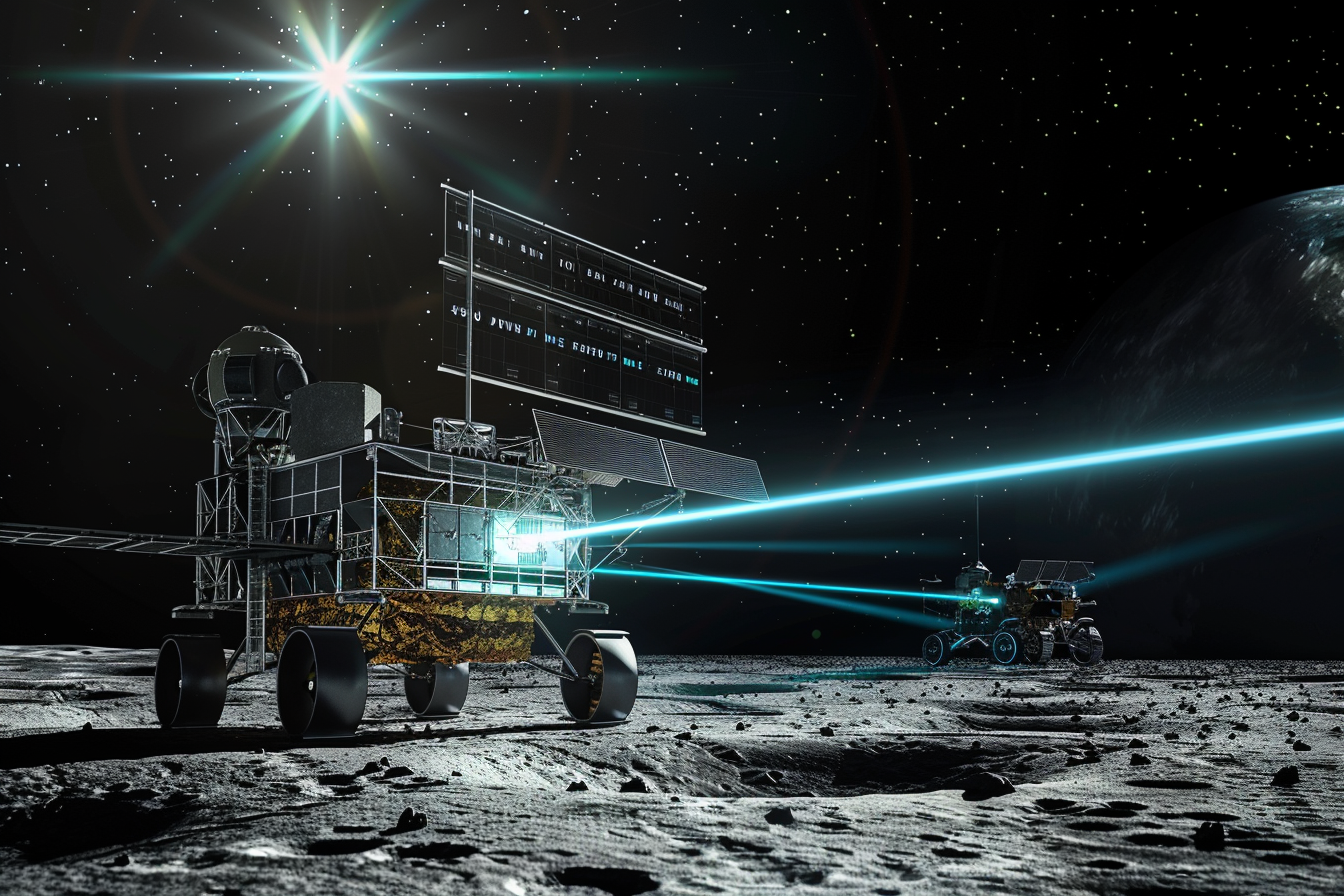
Laser beaming systems transitioned from laboratory demonstrations to field validation between 2023 and 2025, achieving end-to-end efficiencies of 10–20% while demonstrating unique operational flexibility. Star Catcher Industries and Intuitive Machines' November 2025 demonstration at Kennedy Space Center delivered >1.1 kW optical power to off-the-shelf solar panels using multi-wavelength laser suites, powering a commercial lunar terrain vehicle and validating compatibility with existing photovoltaic infrastructure without custom receiver hardware.
DARPA's Persistent Optical Wireless Energy Relay program set distance and power records in 2024–2025, transmitting >800 W over 8.6 km with >20% end-to-end efficiency during 30-second pulses. NASA's 2025 orbital beaming study projected 540 W DC delivery from 3 kW laser satellites in 800 km polar lunar orbits, with InGaAs photovoltaic receivers at 50% conversion efficiency serving multiple surface assets during darkness periods.
While system efficiency lags direct solar PV (30–35%) or fission conversion (25–30%), beaming provides tactical advantages: steerable kilowatt-class transmission enables rover operations in permanently shadowed craters without cable infrastructure, emergency power backup if primary generation fails, and ISRU processing in shadowed regions accessing water ice deposits. Current 100–200 kg/kW mass ratios versus 30–85 W/kg for solar arrays position beaming as flexible distribution infrastructure within hybrid grids rather than primary baseload generation.
Hybrid Grid Integration and ISRU Coupling
The convergence of fission baseload, solar generation, and laser distribution within integrated microgrids addresses the dominant electrical challenge: in-situ resource utilization oxygen production requiring 60–70 kW continuous loads. NASA and ESA process modeling documents 24.3 ± 5.8 kWh per kilogram liquid oxygen via ilmenite-based hydrogen reduction at 600–1,600°C followed by water electrolysis, with beneficiation enrichment emerging as the top sensitivity factor for total power demand.
NASA Glenn Research Center's architecture trade studies model dual-microgrid topologies: a habitat network drawing ~20 kW during crew occupancy (environmental control, life support, communications) dropping to 2 kW keep-alive during dormancy, interconnected with separate ISRU/mining networks via 3 kV AC transmission minimizing conductor mass for kilometer-scale distribution. Sandia National Laboratories' Secure Scalable Microgrid testbed validated autonomous controllers coordinating distributed resources across DC habitat and ISRU microgrids, simulating blackout scenarios and optimal dispatch strategies minimizing battery cycling.
This integration requires standardized interface converters operating at >95% efficiency per International Space Power System Interoperability Standards, fault-tolerant protection schemes capable of interrupting hundreds of amperes at 120 VDC in vacuum without sustained arcing, and autonomous decision-making algorithms managing multi-day eclipse transitions without real-time Earth intervention due to communication latencies. Persistent gaps in dust-resistant connector designs (TRL 3–5), regenerative fuel cell qualification for tens-of-kilowatts scale (TRL 4–5), and integrated non-nuclear system testing create maturation priorities for the 2026–2030 window.
Technology Readiness Assessment and Critical Gaps
As of late 2025, power generation technologies occupy mid-range Technology Readiness Levels with clear maturation pathways but persistent capability gaps:
Fission Surface Power (TRL 5–6): Reactor thermal-hydraulics and HALEU fuel forms demonstrated in non-nuclear prototype tests; Stirling power conversion units validated through Space Radioisotope Generator heritage at TRL 5–6 for individual components; deployable radiators and NaK thermal loops tested in relevant environments but not integrated with nuclear heat sources. The complete 40 kWe flight system remains at TRL 3–4 absent full non-nuclear system-level testing, with Phase 2 development targeting late-2020s launch readiness contingent on regulatory approvals and HALEU supply chain scale-up.
Vertical Solar Arrays (TRL 6): Prototype systems successfully tested in thermal-vacuum chambers, abrasive lunar simulant exposure, and mechanical deployment cycles at Johnson Space Center and Langley Research Center. The January 2025 Blue Ghost electrodynamic dust shield demonstration advanced dust mitigation from TRL 4–5 to TRL 7–8, though long-duration multi-year operation under actual lunar dust conditions requires validation. Regenerative fuel cell storage remains at TRL 4–5 for Artemis power levels, lacking demonstrated lunar surface operation.
Laser Power Beaming (TRL 5–6): High-power fiber lasers with integrated beam combining and thermal management demonstrated in terrestrial conditions; InGaAsP photovoltaic receivers achieving 50–53.6% conversion efficiency in laboratory settings; autonomous beam acquisition and tracking algorithms validated over kilometer-scale distances. System-level integration within operational lunar microgrids and multi-year reliability under thermal cycling and radiation exposure require advancement to TRL 7–8.
Critical gaps conditioning commercial scalability include: integrated end-to-end testing of fission systems with realistic ISRU electrical loads and lunar environmental simulation; multi-year dust mitigation validation for solar connectors and cable interfaces; energy storage down-selection between regenerative fuel cells and advanced solid-state battery chemistries for extreme temperature operation; and regulatory pathway clarification for commercial lunar fission deployments establishing safety certification timelines and liability frameworks.
Strategic Decision Support
The analysis supports evaluation of power infrastructure investment and partnership strategies during the 2026–2030 maturation period preceding Artemis operational deployments. Understanding the documented technical progression—KRUSTY reactor achieving 100% autonomous load-following success, electrodynamic dust shields advancing to TRL 7–8 via successful Blue Ghost demonstration, DARPA laser beaming reaching 20% efficiency over 8.6 km—coupled with $350M federal fission funding allocation and fragmented 24+ month regulatory approval timelines could inform positioning decisions as commercial platforms transition from government-sponsored demonstrations to revenue-generating operations.
Organizations establishing relationships with NASA Phase 2 fission contractors during 2025–2027 contractor down-selection, securing partnerships with CLPS lander providers for solar array deployment services, or developing electrodynamic dust shield licensing agreements may achieve advantageous positioning when Artemis Base Camp infrastructure procurement accelerates in the late 2020s. The convergence of fission baseload capabilities (150 kg/kWe, 10-year autonomous life), solar generation advantages (30–85 W/kg during illumination), and laser distribution flexibility (steerable kilowatt-class beams for mobile assets) suggests opportunities in hybrid grid integration, autonomous microgrid control software, and power-as-a-service business models.
The documented capability gaps—HALEU supply chains at 900 kg/year versus multi-ton demand, dust mitigation technologies at TRL 3–5 for critical interfaces, regenerative fuel cells unvalidated at operational scale—indicate where private-sector innovation in reactor manufacturing, modular grid controllers, or turnkey deployment services could address constraints that government programs face in scaling beyond demonstration articles. Commercial viability remains contingent on regulatory streamlining reducing interagency approval timelines, launch cost trajectories reaching <$1,000/kg to lunar surface via reusable vehicles, and demonstration of multi-year operational reliability under actual lunar environmental conditions rather than simulant-based testing.
Research Scope and Sources
Scope: 2020–2025 analysis of NASA Fission Surface Power Phase 1 contractor studies, KRUSTY reactor demonstration testing, 500+ ISS solar array heritage missions, and DARPA POWER laser beaming validation campaigns, examining programs by NASA Glenn Research Center, Lockheed Martin, Westinghouse, Astrobotic Technology, Star Catcher Industries, Sandia National Laboratories, and Oak Ridge National Laboratory.
Sources:
Peer-reviewed technical publications and NASA Technical Reports Server documents on fission reactor performance metrics, solar array thermal-vacuum testing protocols, and laser beaming end-to-end efficiency measurements
Regulatory frameworks including NSPM-20 interagency nuclear safety review protocols, FAA Advisory Circular AC 450.45-1 space nuclear licensing guidance, and International Space Power System Interoperability Standards
Corporate disclosures from Phase 1 fission contractors, Commercial Lunar Payload Services providers, and laser power beaming technology developers including mission announcements and technical specifications
Market analyses and federal budget allocations including NASA's $350M FY2026 Fission Surface Power directive and Artemis infrastructure deployment projections through 2035