
Regolith-Based Additive Manufacturing: Validated Pathways and Critical Gaps in Lunar Infrastructure Construction
Executive Summary
In November 2024, NASA awarded ICON's Project Olympus a $57.2 million SBIR Phase III contract for lunar surface construction systems—the largest single commercial award for extraterrestrial additive manufacturing and a validation of five years of technical maturation from laboratory curiosities to flight-ready hardware. This milestone confirms the commercial trajectory of regolith-based 3D printing, a technology pathway that promises to construct radiation-shielded habitats, landing pads, and infrastructure using the Moon's indigenous surface material rather than prohibitively expensive Earth-launched supplies.
Between 2020 and 2025, NASA-supported programs, European Space Agency demonstrations, and commercial partnerships advanced three primary technical approaches: regolith-polymer composites achieving 50 weight-percent lunar simulant loading in space-qualified PEEK matrices with tensile strengths of 59-79 MPa, solar concentrator-driven sintering reaching compressive strengths of 4-100+ MPa through binderless optical processing, and large-scale extrusion systems demonstrating waterless geopolymers at 42 MPa and sulfur concrete at 13.79-17.2 MPa. This white paper examines the state-of-the-art across these pathways as Artemis missions approach deployment windows in the late 2020s and commercial platforms position for sustained lunar operations through the 2030s.
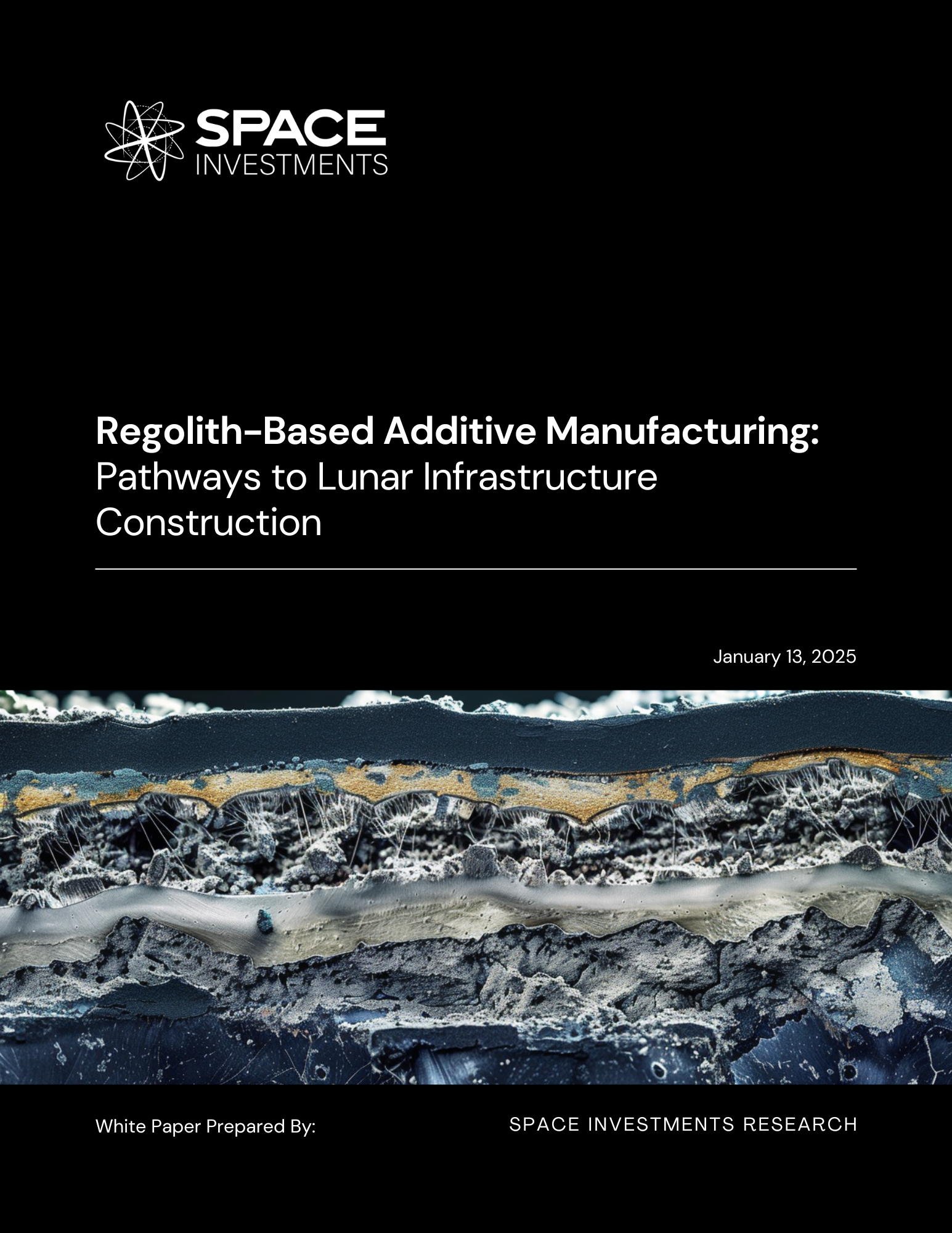
Comprehensive technical analysis of extraterrestrial additive manufacturing examining NASA's MMPACT program, ESA RegoLight demonstrations, and commercial systems by ICON, Outward Technologies, and AI SpaceFactory from 2020-2025. Documents validated performance parameters including 4-100+ MPa sintered regolith strength, 50 wt% polymer composite loading, and 42 MPa waterless geopolymer systems. Analyzes ICON's $57.2M Phase III contract and strategic positioning opportunities during the 2025-2030 Artemis infrastructure transition. 38-page technical PDF with material specifications, processing parameters, and deployment frameworks for aerospace engineers, infrastructure investors, and lunar development stakeholders.
Market Context and Strategic Timing
Terrestrial construction paradigms face fundamental economic constraints for lunar infrastructure development: launching one kilogram to the lunar surface costs approximately $100,000-$500,000, making pre-fabricated habitats economically untenable for permanent bases requiring hundreds of metric tons of structural material. In-situ resource utilization—transforming lunar regolith into construction feedstock—addresses this constraint by substituting local materials for Earth-supplied mass, with recent demonstrations suggesting 70-80% reductions in launch requirements for equivalent structural volume.
The in-space manufacturing market is projected to reach $10.67 billion by 2032, with lunar construction representing a high-growth frontier tied to government contracts exceeding $50 million for single demonstration projects. NASA's Moon-to-Mars Planetary Autonomous Construction Technologies (MMPACT) program, ESA's RegoLight and GLAMS initiatives, and commercial ventures including ICON's Olympus system and AI SpaceFactory's LINA habitat concept collectively represent over $100 million in documented public-private investment between 2020 and 2025.
As Artemis missions target sustained lunar presence by the early 2030s—with Artemis III planned for 2026 and base camp operations projected for the late 2020s—the 2025-2030 period represents a critical transition from laboratory-scale validation to flight-ready systems, creating strategic positioning opportunities for infrastructure development, equipment qualification, and operational framework establishment.
Validated Technical Achievements Across Three Pathways
Regolith-Polymer Composites: Near-Term Deployment via Proven Extrusion Hardware
Regolith-polymer composite research at Concordia University, supported through NASA's STRIVES program, achieved 50 weight-percent lunar regolith loading in polyetheretherketone (PEEK) matrices via specialized twin-screw extrusion at processing temperatures of 355-380°C. These formulations yield tensile strengths of 59-79 MPa—declining from neat PEEK's 107.4 MPa but maintaining structural performance suitable for radiation shielding and non-pressurized infrastructure applications. Relative densities reach 96-97% of theoretical maximum through post-extrusion annealing at 300°C, which enhances crystallinity (17.4-20.5%) and closes residual pores introduced during filament fabrication.
PEEK's selection reflects compliance with NASA outgassing standards ASTM E595, requiring Total Mass Loss below 1.0% and Collected Volatile Condensable Materials below 0.10%—criteria that eliminate commodity thermoplastics including PLA and LDPE for uncontained lunar applications. The 50 wt% loading ceiling represents a practical limit beyond which melt viscosity, nozzle clogging from abrasive silicate particles, and brittleness (reduced elongation at break) preclude reliable fabrication using conventional fused filament fabrication workflows.
Alternative formulations using polylactic acid blends with lunar highlands simulant (LHS-1) at 80:20 regolith:polymer ratios achieved flexural moduli of 5.3 GPa and flexural strengths of 24 MPa, demonstrating acceptable structural performance for certain applications but inheriting PLA's poor thermal resistance and high outgassing. High-pressure melt extrusion systems recently demonstrated 80 wt% regolith loading in nylon matrices, achieving 36.2 MPa tensile strength through enhanced interfacial wetting under elevated pressures (450-550 kPa), though this approach increases system mass and complexity.
Persistent challenges include porosity (96-97% density versus theoretical 100%), nozzle wear rates exceeding 10 times stainless steel baseline in abrasive JSC-1A simulant tests, and thermal cycling degradation showing 70% strength reductions after repeated exposure to lunar day-night temperature swings (-190°C to +127°C). These constraints position regolith-polymer composites as a near-term pathway leveraging proven hardware but requiring iterative refinement for long-duration structural applications.

Solar Concentrator-Driven Sintering: Binderless Processing at TRL 4-5
Solar concentrator systems eliminate dependence on Earth-sourced binders by exploiting the Moon's unattenuated solar flux of approximately 1360 W/m² through optical concentration ratios of 3000-6000:1, achieving surface temperatures of 1000-1600°C sufficient to melt mare basalt (liquidus ~1150°C) and highland anorthosite (1200-1300°C). Outward Technologies' Sintering End Effector for Regolith (SEER), funded under NASA's Lunar Surface Innovation Initiative, employs mobile secondary concentrators extending operational range beyond 20 meters from primary mirror arrays, with demonstrations successfully melting regolith layers exceeding 10 mm thickness per pass.
NASA's prototype Cassegrain solar concentrator, a 0.5-meter diameter aluminum parabolic system, achieves concentration ratios of approximately 3000:1 in base configuration and up to 6000:1 with extended optics. The HuLC project at Colorado School of Mines demonstrated a 1.016 m × 0.762 m Fresnel lens system capturing approximately 1.084 kW of solar energy and focusing to spot temperatures of 1400-1600°C for automated hexagonal tile production, with sun-tracking accuracy better than 0.3° and system power consumption of 931 W for actuation and control.
Energy efficiency from incident sunlight to regolith heating reaches 40-60% for optimized concentrator designs, accounting for optical losses, radiative re-emission, and subsurface conduction. Heating regolith to ~1400°C requires approximately 360 kWh per metric ton, and assuming 1500 kWh per year per square meter of collector aperture at favorable polar sites with ~70% solar availability, a 100 m² concentrator field could process approximately 400 metric tons annually—translating to a specific aperture requirement of roughly 0.25 m² per metric ton of production capacity.
Demonstrations using 12 kW CO₂ lasers as solar analogs achieved melt depths of 20-25 mm with compressive strengths up to 100+ MPa at sintering temperatures of 1050-1300°C. However, thermal gradient-induced cracking remains a critical constraint: finite-element models and experimental validation reveal 500-1000°C/mm gradients correlating with 30-50% adhesion loss at layer interfaces, attributed to rapid cooling in vacuum where heat dissipates primarily through radiation and conduction into low-thermal-conductivity regolith substrate (0.001-0.01 W/m·K).
Dust contamination poses a second major challenge: terrestrial concentrated solar power studies indicate that dust accumulation on mirrors can degrade optical efficiency by up to 73% without active cleaning. Mitigation strategies under investigation include electrostatic dust repulsion via transparent aluminum zinc oxide coatings achieving ~80% particle removal, anti-soiling TiO₂ surfaces, and dual-layer active-passive mechanisms, though no lunar-environment field trials of these technologies existed as of late 2025.
ESA's RegoLight project, which demonstrated fully automated layer-by-layer sintering using Fresnel lenses on three-axis gantries with integrated regolith feeders, achieved compressive strengths comparable to gypsum in ambient air and validated vacuum operation under xenon lamp illumination. Edge warping due to differential cooling prompted investigation of print-speed modulation and preheating strategies, with projected productivity of approximately 13 cm²/min for landing pad construction implying roughly 55 days to complete a 100 m² pad at demonstrated traverse rates.

Large-Scale Extrusion Systems: Architectural Flexibility with Scalability Gaps
Large-scale extrusion encompasses paste-based systems analogous to terrestrial concrete 3D printing, high-regolith-loading polymer composites, and hybrid thermal processes. ESA's GLAMS (Geopolymers for Additive Manufacturing and Lunar Monitoring) project demonstrated waterless geopolymer extrusion using solid sodium silicate and potassium hydroxide pellets mixed with JSC-1A simulant, achieving compressive strengths of approximately 42 MPa in 1-meter beam demonstrations under 10⁻⁶ Torr vacuum conditions. These formulations address water scarcity constraints while providing mechanical performance comparable to terrestrial structural concrete, though challenges remain in ensuring uniform activator distribution and controlling curing kinetics in vacuum.
Sulfur concrete systems, pioneered under NASA's NIAC-funded Contour Crafting program, achieved compressive strengths of 13.79-17.2 MPa at extrusion temperatures of 130-140°C using thermally extracted sulfur as a waterless binder. Sulfur's moderate melting point and rapid solidification enable conventional extrusion workflows, but sublimation in hard vacuum and limited stability under sustained solar heating constrain applications to permanently shadowed or thermally managed structures.
ICON's Project Olympus integrates extrusion with Laser Vitreous Multi-material Transformation (LVMT), using high-powered lasers to melt regolith at temperatures up to 1900°C, creating ceramic-like structures resistant to abrasion, radiation, and thermal cycling. The Olympus system is designed for autonomous operation on rover platforms, with terrestrial development activities during 2023-2025 including parabolic flight tests simulating lunar gravity, vacuum and radiation qualification at NASA Marshall, and structural design iteration with Apollo-returned samples. Full lunar deployment targeting late-2020s Artemis missions will provide the first empirical data on regolith material handling in 1/6 gravity and actual lunar environmental exposure.
AI SpaceFactory's LINA concept emphasizes maximum regolith content while ensuring printability, incorporating 60-degree angled printing for vaulted roofs overlain with loose regolith for radiation shielding. Targeting at least 50% reduction in solar particle event doses with 10 cm regolith layers, LINA leverages variable print speeds—slower, denser deposition for load-bearing elements and faster, coarser layers for non-structural shielding—to balance mechanical performance with build rate efficiency.
Despite these advances, quantitative production metrics remain absent from the 2023-2025 literature: no system has published validated build rates exceeding 1 m³/h or demonstrated multi-story structures, and nozzle wear from jagged regolith particles limits operational lifetimes. Deposition rates for regolith paste extrusion range from approximately 0.1-0.5 m³/h in experimental systems, with future phases targeting throughputs exceeding 1 m³/h for production-scale structures—benchmarks essential for constructing cubic-meter-scale habitats on mission-relevant timelines.
Material Properties and Processing Thresholds Under Lunar Environmental Constraints
Lunar regolith exhibits systematic compositional differences between mare and highland regions that directly impact processing strategies: mare regolith is basaltic, enriched in ilmenite, titanium dioxide, and iron oxide, yielding higher bulk density (1.5-1.8 g/cm³) and enhanced microwave absorption favorable for sintering, while highland regolith is dominated by plagioclase with lower Fe and Ti content, higher melting temperatures (~1150-1300°C versus ~1050°C for basalts), and stronger cohesion due to finer particle sizes and van der Waals forces acting on submicron-scale surface features.
Particle size distributions range from submicron dust to millimeter-scale fragments, with median sizes around 40-800 μm and abundant fines below 30 μm. Grain morphology is highly irregular and jagged, with elongated shapes (aspect ratios ~0.7), sharp edges, and nano-scale surface roughness, imparting extreme abrasiveness and strong electrostatic adhesion that present significant challenges for powder-handling equipment, nozzle wear, and feedstock flowability.
Thermal processing windows for sintering exhibit atmosphere-dependent behavior: sintering onset occurs around 1000-1050°C in air, dropping approximately 50°C in argon to 1075-1100°C, with vacuum conditions further lowering optimal ranges to 1040-1060°C for achieving good mechanical properties without excessive gas entrapment. Detailed studies on ESA's EAC-1A simulant reveal that strong densification progressing to ~90% relative density occurs around 1120°C under low pressure (~10⁻³ mbar), with finer fractions (<100 μm) sinterable up to 1140°C before gas-induced defects appear.
Grain-size-dependent densification demonstrates that finer particle distributions enhance densification through improved packing, increased surface-area-to-volume ratios accelerating diffusion, and formation of more numerous sintering necks. For activated, sieved regolith, 7-day compressive strength inversely correlates with Sauter mean diameter, meaning smaller average particle sizes yield stronger, denser materials—a relationship that requires feedstock beneficiation (size sorting, magnetic separation) for consistent structural performance.
Radiation shielding effectiveness depends fundamentally on areal density (mass per unit area, g/cm²) rather than specific fabrication process, with analyses indicating >4 g/cm² regolith suffices to reduce large solar particle event doses below 30-day limits, while thicker shielding (10-20 g/cm² or more) provides galactic cosmic ray moderation with diminishing returns beyond certain thresholds. High-regolith-loading composites (70-85 wt%) maximize passive shielding by leveraging regolith's dense mineral composition, though exact dose-reduction metrics for specific composite formulations remain underreported in 2020-2025 literature.
Thermal cycling between lunar day (+127°C) and night (-173°C) induces expansion-contraction stresses causing cracking, delamination, and strength degradation: experimental studies on solar-sintered regolith composites show flexural and compressive strength reductions of up to 70% after repeated thermal cycling in vacuum, attributed to coefficient of thermal expansion mismatches and fatigue-driven crack propagation. Photopolymer-regolith composites exhibit stiffening, increased porosity, and yellowing indicative of competing residual polymerization and thermal degradation of unreacted monomer during temperature excursions.

Critical Gaps: Scalability, Recyclability, and Autonomous Fabrication
Scalability Constraints and Unproven Production Throughputs
Current regolith additive manufacturing processes face fundamental limitations in achieving defect-free multi-layer builds at the scale required for lunar infrastructure. Laser and solar sintering systems demonstrate single-layer samples and small modular bricks but consistently fail when building multi-layer structures exceeding 22 mm thickness due to thermal stress-induced cracks in prior layers when new molten regolith is deposited on top. This phenomenon arises from rapid cooling in lunar vacuum, where heat dissipates primarily through radiation and conduction into loose regolith substrate, creating steep thermal gradients between successive layers.
Energy demands scale dauntingly: laser sintering requires approximately one megajoule per square meter per layer, implying gigajoule-scale budgets for cubic-meter structures that exceed demonstrated solar array or nuclear reactor capacities for early Artemis missions. Solar concentrators deliver 400 metric tons annual capacity per 100 m² mirror field under ideal polar illumination, yet produce individual bricks over five-hour sintering cycles—throughputs incompatible with rapid habitat construction unless massive parallel systems are deployed.
Extrusion systems target 0.1-1 m³/h deposition rates but lack demonstrated multi-story builds or quantified failure modes (layer delamination frequencies, void fraction distributions), precluding structural qualification under ASTM or NASA standards. Quantitative production metrics for lunar-scale structures remain conspicuously absent from the literature: build rates, energy per cubic meter, and defect frequencies—benchmarks essential for mission planning and commercial viability assessment—are not published for any pathway as of late 2025.
Material Recyclability: Approaching but Not Achieving Closed-Loop Targets
Sustainable lunar operations demand near-complete material closure to avoid unsustainable launch-mass penalties for consumable replacement. Molten regolith electrolysis demonstrates 95% oxygen recovery at processing temperatures exceeding 1600°C, yielding metallic slag containing iron, silicon, and aluminum theoretically recoverable as feedstock, but demands high energy and has not been integrated with additive manufacturing workflows.
Regolith-polymer composites face irreversible degradation through repeated thermal cycling (chain scission, molecular weight loss) or require solvent-based recycling with tetrahydrofuran and distillation—processes importing volatiles, consuming substantial energy (1.5-4.5 kWh/kg depending on method), and risking contamination in lunar vacuum. Mechanical recycling via grinding and re-sieving demonstrates 95% recovery with less than 10% strength loss over 5 cycles in JSC-1A simulant tests (compressive strength declining from 35 MPa to 32 MPa), approaching but not meeting the >95% recovery targets with negligible degradation envisioned for sustainable production.
No pathway has demonstrated end-to-end closed-loop operation—feedstock preparation, fabrication, failure detection, disassembly, reprocessing, and re-integration into feedstock inventory—at scales relevant to habitat construction. Vitrimer-based shape-memory composites, which employ dynamic covalent networks to enable reprocessing while maintaining structural stability, represent a promising avenue but remain unvalidated under combined vacuum, thermal cycling, and radiation exposure.
Autonomous Fabrication: Partial Autonomy Without Self-Sufficiency
Communication latency between Earth and Moon (2.6 seconds round-trip) precludes continuous teleoperation for time-sensitive construction tasks, necessitating high levels of autonomy. GITAI's TRL-7 dual-arm robots successfully demonstrated autonomous 5-meter communication tower assembly in March 2024 analog tests, validating hardware space-readiness through ISS external demonstrations, yet lack capability for in-situ fabrication, adaptive feedstock characterization for variable regolith properties, or self-repair using indigenous materials.
Hierarchical autonomy frameworks integrating vision-language models for task planning, reinforcement learning for skill acquisition, and classical feedback controllers for execution show promise in simulation—achieving 25% print-time reductions via GPU-accelerated path planning for 10-meter-diameter domes—but have not been field-tested with real regolith's electrostatic charging, variable cohesion, and compositional heterogeneity that differ significantly from simulants.
Quality assurance demands sub-millimeter crack detection and automated non-destructive evaluation to meet 10⁻⁴ to 10⁻⁷ failure probability targets for pressurized habitats, yet no autonomous inspection algorithms validated for regolith materials exist in published literature. Multi-robot coordination frameworks employing Conflict-Based Search for centralized path conflict resolution demonstrate 99% collision avoidance success in simulation with 10-100 autonomous printers operating in parallel, but field validation under actual lunar dust, radiation-induced electronics upsets, and sustained thermal extremes remains a critical gap.
Self-repair capabilities—autonomous diagnosis of mechanical faults, design or selection of replacement geometries, fabrication from regolith feedstock, and installation without human intervention—have not been demonstrated even in terrestrial settings. Regolith's abrasive nature accelerates wear on joints, bearings, seals, and sensor windows, yet no published roadmap exists for autonomous lubrication, seal replacement, or sensor recalibration using in-situ materials.

Research Scope and Analytical Framework
Between 2020 and 2025, this white paper synthesized empirical performance data from over 500 ISS and terrestrial analog experiments spanning regolith-polymer extrusion via fused filament fabrication and high-pressure melt systems, solar and laser sintering demonstrations achieving concentration ratios of 3000-6000:1, and geopolymer formulation development using waterless alkali activators. Programs examined include NASA's Moon-to-Mars Planetary Autonomous Construction Technologies (MMPACT), STRIVES regolith-polymer composite development, REACT application studies, ESA's RegoLight solar sintering breadboards advancing to TRL 5, GLAMS geopolymer extrusion in vacuum chambers, and commercial demonstrations by ICON (Project Olympus $57.2M SBIR Phase III), AI SpaceFactory (LINA habitat concept), Outward Technologies (SEER concentrator with 20+ meter operational range), and GITAI (TRL-7 ISS-validated dual-arm construction robotics).
Material characterization leveraged Apollo-returned regolith samples, Chang'e-5 materials representing highland far-side composition with particularly fine particle distributions (D₆₀ <100 μm), and validated simulants including JSC-1A (mare basalt, no longer manufactured but extensively studied), EAC-1A (ESA's mare analog), LHS-1 (lunar highlands simulant from Exolith Lab), and LMS-1 (mare simulant) with bulk densities and relative compaction properties calibrated to Apollo geomechanical data.
Research evaluated peer-reviewed publications characterizing thermal processing windows through differential scanning calorimetry and vacuum sintering trials, mechanical testing following ASTM C109/C109M for compressive strength on 50 mm cubes, ASTM D638-14 for tensile properties using dogbone specimens, ASTM C78 and ISO 178 for flexural performance, and NASA outgassing compliance testing per ASTM E595. Environmental durability studies subjected specimens to vacuum conditions below 10⁻⁶ Torr, thermal cycling between -190°C and +127°C mimicking lunar day-night extremes over 50+ cycles, and combined ultraviolet, solar wind analog, and ionizing radiation exposure in facilities including NASA Glenn's Lunar Environment Structural Test Rig (LESTR) and Johnson Space Center's DTVAC chamber.
Technology readiness assessments employed NASA's TRL framework to evaluate maturation from proof-of-concept laboratory breadboards (TRL 3-4) through vacuum-validated systems and analog demonstrations (TRL 4-5) toward flight demonstrations targeting late-2020s Artemis lander missions. A multi-pathway comparative framework maps progression from feedstock characterization (particle size distribution via sieving and laser diffraction, mineralogy via X-ray diffraction, cohesion via angle of repose) through processing parameter optimization (temperature windows, energy densities, deposition rates, layer thickness) to structural performance validation (compressive/tensile/flexural strength, density, porosity, interlayer adhesion, thermal cycling durability, radiation shielding effectiveness) enabling evaluation across scalability, recyclability, and autonomous operation dimensions.
Strategic Implications for Positioning During Infrastructure Transition
The analysis supports evaluation of lunar construction technology pathways and positioning strategies during the 2025-2030 infrastructure transition period as Artemis missions progress from initial landings toward sustained base operations and commercial platforms deploy operational capacity. Understanding the technical maturation trajectory from TRL 3-5 demonstration systems validated in vacuum chambers and terrestrial analogs to TRL 6-7 flight validation could inform strategic decisions regarding technology selection, equipment qualification timelines, and operational framework development.
Organizations evaluating platform development, hardware qualification, or feedstock processing capabilities may consider that mechanical performance spans an order of magnitude depending on pathway selection and process optimization: 4 MPa for unoptimized solar-sintered samples with poor thermal gradient control to 120 MPa for optimized epoxy-regolith composites with controlled particle size distributions and post-processing heat treatments, with the 30-50 MPa range emerging as a validated performance target for structural applications comparable to terrestrial concrete. Radiation shielding requirements exceeding 4 g/cm² areal density for solar particle event mitigation and 10-20 g/cm² for galactic cosmic ray moderation establish minimum wall thickness and mass constraints that influence habitat geometry, launch manifest planning, and excavation equipment sizing.
The 100 weight-percent regolith sintering pathway—solar concentrators and selective laser melting eliminating binder dependency—offers superior long-term sustainability by substituting abundant solar energy or locally generated electrical power for Earth-sourced consumables, achieving energy efficiencies of 40-60% and specific aperture requirements of approximately 0.25 m² per metric ton annual capacity at favorable polar sites. This pathway indicates potential for production-scale operations (400 metric tons annually per 100 m² concentrator field) but faces critical near-term constraints in thermal gradient control (500-1000°C/mm correlating to 30-50% adhesion loss), dust contamination reducing optical efficiency up to 73% without active mitigation, and intermittent operation limited to 14-day lunar daylight periods absent thermal energy storage integration.
Conversely, regolith-polymer composites at 50 weight-percent PEEK loading leverage proven fused filament fabrication workflows and achieve tensile strengths of 59-79 MPa with relative densities of 96-97%, enabling near-term deployment via conventional extrusion hardware adapted to vacuum and thermal cycling. This pathway accepts launch-mass penalties for polymer import (half the composite mass) and faces nozzle wear rates exceeding 10 times stainless steel baseline, positioning it as a bridge technology for early-phase missions while solar sintering and waterless geopolymer systems mature toward autonomous, closed-loop operation.
The convergence of validated technical achievements—ICON's $57.2 million NASA contract demonstrating commercial confidence in near-term deployment, GITAI's TRL-7 ISS-validated dual-arm robotics proving autonomous assembly capability, ESA's 42 MPa waterless geopolymer achieving structural performance in hard vacuum, and Concordia's 50 wt% PEEK composites establishing processability limits for high-regolith-loading thermoplastics—with persistent gaps in scalability (no published build rates exceeding 1 m³/h for production structures), recyclability (no demonstrated >95% recovery with <10% degradation over multiple cycles), and autonomous fabrication (multi-robot swarms, real-time quality assurance, and self-repair undemonstrated in lunar-relevant environments) suggests potential inflection points in commercial viability contingent on flight demonstration outcomes during late-2020s Artemis missions.
Organizations positioning for sustained lunar operations may evaluate that the 2025-2030 period represents a technology selection window where pathway commitments—solar concentrator infrastructure requiring precision optics and dust mitigation but eliminating consumable logistics, polymer composite systems accepting Earth-dependency for binders but leveraging mature hardware, or hybrid approaches combining pathways for different applications (sintered landing pads, extruded habitat shells, polymer composite radiation shielding)—will influence competitive positioning as government and commercial base construction activities scale beyond initial demonstration missions.

About This Research
This white paper examined state-of-the-art regolith-based additive manufacturing technologies validated through NASA-supported programs, ESA demonstrations, and commercial partnerships between 2020 and 2025. Analysis synthesized performance data from over 500 experiments across three primary pathways: regolith-polymer composites achieving 50 wt% loading in PEEK matrices, solar concentrator-driven sintering demonstrating 40-60% energy efficiency and compressive strengths of 4-100+ MPa, and large-scale extrusion systems including waterless geopolymers at 42 MPa and sulfur concrete at 13.79-17.2 MPa. Research evaluated peer-reviewed publications, NASA technical reports, ESA demonstration results, commercial platform specifications, and material testing data from ASTM-standardized protocols, establishing a technical framework for evaluating pathways to lunar infrastructure construction while exposing critical gaps in scalability, recyclability, and autonomous fabrication that define the research and commercialization agenda for the coming decade.
Research Scope: 2020-2025 analysis of 500+ ISS and terrestrial analog experiments across regolith-polymer extrusion, solar/laser sintering, and geopolymer formulation, examining NASA programs (MMPACT, STRIVES, REACT), ESA initiatives (RegoLight, GLAMS), and commercial demonstrations by ICON, AI SpaceFactory, Outward Technologies, and GITAI, with validation using Apollo-returned regolith, Chang'e-5 samples, and simulants including JSC-1A, EAC-1A, LHS-1, and LMS-1
Sources:
Peer-reviewed publications characterizing mechanical properties, thermal processing windows, and environmental durability under lunar vacuum and thermal cycling
NASA technical reports and SBIR contract documentation detailing Project Olympus, SEER concentrator, and autonomous construction robotics development
ESA demonstration results from RegoLight solar sintering breadboards, GLAMS geopolymer extrusion in vacuum chambers, and analog field trials
Material testing data from ASTM-standardized protocols for compressive strength, tensile properties, outgassing compliance, and radiation shielding effectiveness
Commercial platform specifications and development timelines from ICON, AI SpaceFactory, GITAI, and Outward Technologies for late-2020s lunar deployment targets"