
Space as a Platform for Advanced Biotechnology: Research Publication
Microgravity-Enabled Innovation in Regenerative Medicine, Tissue Engineering, and Pharmaceutical Production
Executive Summary
In September 2025, the FDA approved Merck's reformulated pembrolizumab for subcutaneous injection—the first pharmaceutical product informed by ISS crystallization research, addressing a $25 billion annual market. This validates microgravity's commercial potential for biomanufacturing.
This white paper examines five years of ISS missions (2020-2025) across stem cell organoids, tissue engineering, and pharmaceutical production, documenting outcomes from Cedars-Sinai, Redwire Space, Bristol Myers Squibb, and emerging commercial platforms. As the ISS approaches 2030 retirement, Axiom Station, Starlab, and Orbital Reef are positioning to inherit biomanufacturing capacity, creating strategic opportunities during the 2026-2030 transition window for organizations evaluating orbital platform partnerships, timing market entry, and establishing early-mover positioning in the projected $7.3 billion in-space manufacturing sector.

Comprehensive analysis of microgravity-enabled biotechnology examining ISS missions by Cedars-Sinai, Redwire Space, Merck, Bristol Myers Squibb, and Eli Lilly from 2020-2025. Documents validated outcomes including FDA approval of Merck's pembrolizumab reformulation, scaffold-free organoid maturation, and vascularized tissue engineering breakthroughs. Analyzes commercial platform transition dynamics as Axiom Station and Orbital Reef prepare for 2028-2030 deployment concurrent with ISS retirement. 45-page professional research PDF with technical specifications, regulatory pathway frameworks, and market projections for investment fund managers and aerospace engineers.
Research Context
Terrestrial biotechnology faces fundamental constraints that limit therapeutic development and manufacturing capabilities. Tissue thickness remains restricted to approximately 200 micrometers without functional vascularization due to oxygen and nutrient diffusion limitations. Gravitational forces collapse soft bioprinted constructs during fabrication, preventing the production of thick, anatomically complex tissues. Protein crystallization suffers from sedimentation and buoyancy-driven convection that create heterogeneous particle distributions and reduce structural quality for drug design applications. Over 100,000 patients await organ transplants in the United States, while conventional organoid models struggle to replicate aging-related disease pathways within practical research timeframes.
This white paper examined ISS missions conducted by Cedars-Sinai Medical Center, Redwire Space, the National Stem Cell Foundation, Merck, Bristol Myers Squibb, Eli Lilly, and Varda Space Industries between 2020 and 2025. Research analyzed stem cell-derived organoid formation in brain, cardiac, and liver tissues; 3D-bioprinted vascularized constructs including knee meniscus, cardiac patches, and perfusable liver segments; and pharmaceutical crystallization campaigns targeting monoclonal antibodies and small molecule active pharmaceutical ingredients.
The global organoid market reached $1.5-1.86 billion in 2024 with compound annual growth rates of 20-24% projected through 2030, driven by applications in drug screening, disease modeling, and precision medicine. The broader in-space manufacturing sector is projected to expand from $1.58 billion in 2024 to $7.3 billion by 2031. With ISS retirement planned for 2030 and commercial platforms including Axiom Station (targeting 2028 deployment) and Orbital Reef (full operations by decade's end) preparing to inherit biomanufacturing capacity, the 2026-2030 period represents a critical transition window.
Validated Outcomes Across Three Biomanufacturing Domains
Stem Cell Organoid Research
Cedars-Sinai's cardiac organoid experiments demonstrated three-fold size increases and twenty-fold cellular content gains compared to terrestrial controls, with enhanced contractile gene expression and improved calcium handling metrics. These improvements suggest potential for producing larger, more functional cardiac constructs that could inform transplantable tissue development and advanced disease modeling platforms.
The National Stem Cell Foundation conducted six ISS missions since 2019 using induced pluripotent stem cells from Parkinson's disease and primary progressive multiple sclerosis patients. Analysis revealed accelerated maturation characterized by downregulation of neural progenitor genes and upregulation of maturity-associated markers, enabling condensed developmental timescales for studying early disease pathways. Brain organoids cultured in sealed cryovials maintained complete viability over 30-day missions with robust neurite extension upon Earth return, indicating potential for routine orbital culture campaigns.
The University of Zurich's 2020 investigation achieved 100% success rates forming viable liver, bone, and cartilage organoids from human mesenchymal stem cells during 30-day ISS missions, outperforming Earth-based controls in growth metrics and differentiation efficiency. This established proof-of-concept that microgravity enables reliable, reproducible organoid production from adult stem cell sources across multiple tissue types.
Vascularized Tissue Engineering
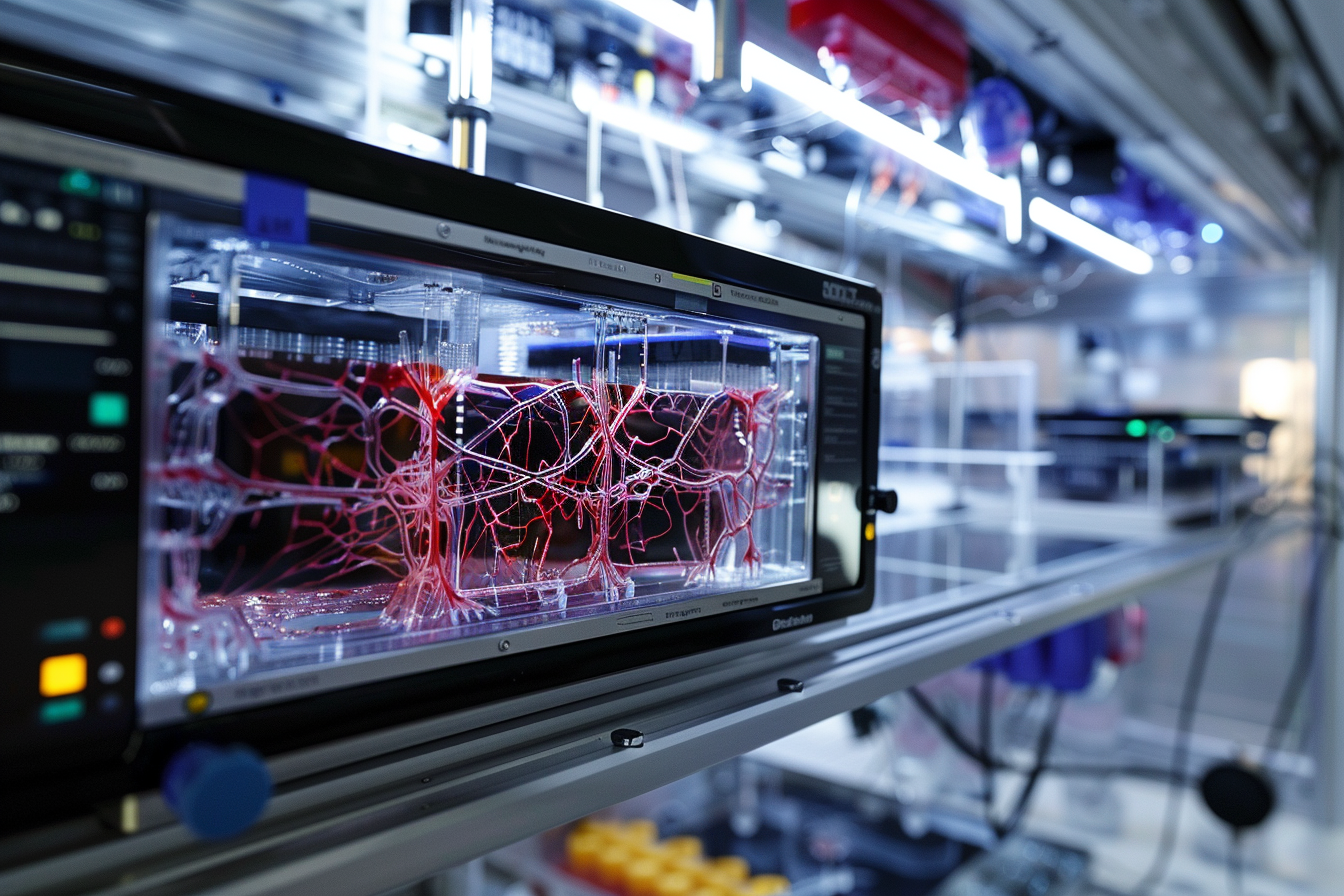
Redwire's BioFabrication Facility, installed on ISS in early 2023, successfully bioprinted the first complete human knee meniscus in space using live human mesenchymal stem cells suspended in collagen bioinks. The construct, cultured for 14 days before Earth return, demonstrated viable cell distribution and anatomically correct shape fidelity, though it exhibited approximately four-fold lower mechanical stiffness compared to terrestrial controls—highlighting ongoing challenges in achieving native tissue properties.
In April 2024, Redwire bioprinted live human cardiac tissue aboard ISS and returned it to Earth for functional testing. Future iterations plan to incorporate bioprinted blood vessels to enhance graft integration and long-term viability. These cardiac constructs aim to develop heart patches for repairing damaged myocardium and advancing personalized medicine platforms.
The Wake Forest Institute for Regenerative Medicine tested 3D-bioprinted liver tissue constructs with embedded vascular channels aboard ISS in August 2025, addressing the 30-day viability limit of avascular liver tissues on Earth. The investigation assessed how microgravity affects cell distribution, adherence, differentiation, and vascular endothelial lining formation—key determinants of long-term tissue function and potential clinical translation.
Pharmaceutical Crystallization and Production
Merck's multi-year pembrolizumab crystallization campaign, beginning with SpaceX CRS-10 in 2017 and continuing through 2022, achieved uniform 39-micrometer particle distributions in microgravity compared to irregular, bimodal distributions in terrestrial crystallization. This uniformity enabled development of lower-viscosity crystalline suspensions suitable for subcutaneous injection rather than requiring lengthy intravenous infusions. In September 2025, the FDA approved an early-stage cancer formulation incorporating these space-informed improvements—the first regulatory validation of orbital pharmaceutical research translating to clinical application.
Bristol Myers Squibb conducted multiple protein crystallization missions via SpaceX CRS-27 and subsequent flights, employing vapor diffusion and batch crystallization methods for biologics optimization. The company's experiments use 30-day growth periods with astronaut monitoring, followed by comprehensive structural and biophysical characterization comparing space-grown crystals against terrestrial controls to identify formulation improvements enhancing stability, dosing precision, and patient outcomes.
Varda Space Industries demonstrated autonomous orbital pharmaceutical manufacturing through its W-1 mission (launched June 2023, landed February 2024), successfully producing metastable Form III ritonavir crystals—a polymorph challenging to manufacture terrestrially. By mid-2025, Varda had completed three successful missions with a fourth in orbit and a fifth planned, raising $187 million in Series C funding to expand flight cadence and open pharmaceutical laboratories supporting monoclonal antibody production. This capsule-based approach eliminates dependence on ISS logistics and crew time, offering a scalable platform for high-value, low-volume pharmaceutical products.

Commercial Platform Transition and Infrastructure Readiness
The ISS National Laboratory facilitated over 75 peer-reviewed publications and 7 patents between 2020 and 2022, with pharmaceutical partners including Amgen and Merck conducting degenerative disease research. In fiscal year 2024, ISS National Lab-sponsored projects attracted $25 million in external, non-NASA funding. Startups that participated in ISS National Lab-sponsored projects subsequently raised approximately $2.4 billion in cumulative capital, demonstrating investor confidence in space-validated technologies.
Axiom Space plans to launch its first commercial module via Falcon Heavy in 2028, initially attaching to ISS before transitioning to independent operations with dedicated Research and Manufacturing Facility capabilities specifically designed for biomanufacturing applications including organoid production, tissue engineering, and pharmaceutical crystallization. This phased approach allows operational validation while ISS infrastructure remains available, reducing technical risk.
Orbital Reef, led by Blue Origin with Sierra Space and Boeing, is designed as a "mixed-use business park in space" featuring 830 cubic meters of pressurized volume, ISS-compatible payload standards, and regenerative life support enabling sustained biomanufacturing operations. The platform explicitly positions biomedical research and pharmaceutical production as core revenue streams, targeting full operations by 2030.
Varda's business model focuses on dedicated free-flying manufacturing spacecraft that produce pharmaceutical crystals in orbit and return products via autonomous reentry capsules, avoiding shared-facility constraints. The company's $329 million total capital raise supports scaling capsule production, expanding laboratory facilities for pre-launch testing, and growing from 130 to 180 personnel to support increased flight rates through 2026.
Technology Maturation Challenges and Regulatory Development
Despite demonstrated technical feasibility, significant barriers impede transition from ISS-based experimentation to profitable commercial biomanufacturing. Current ISS experiments process milligram-to-gram quantities, whereas commercial pharmaceutical manufacturing operates at kilogram-to-ton scales—a six-order-of-magnitude gap requiring substantial advances in orbital fluid handling, continuous processing, and formulation technologies.
Launch costs, while reduced to approximately $3,000 per kilogram via SpaceX Falcon 9 reusability, remain prohibitive for many biotechnology applications. Future projections for fully reusable Starship systems suggest costs could decline to $150 per kilogram depending on flight rates—reductions necessary to offset bioprocessing equipment mass and complexity.
Regulatory frameworks present additional complexity. FDA's current Good Manufacturing Practice regulations under 21 CFR Part 211 mandate on-site facility inspections, creating challenges for orbital production facilities. The September 2025 pembrolizumab approval establishes initial precedent, yet broader questions remain regarding biosimilar requirements, intellectual property for space-manufactured crystal forms, and cGMP compliance mechanisms for commercial stations. If terrestrial replication fails to achieve bioequivalence for generics due to polymorphic or structural differences unique to microgravity production, regulatory pathways become substantially more complex.
Automation and robotics are essential to overcoming crew-time constraints and enabling commercial scalability. Redwire's commercial manufacturing facilities and Space Tango's Mambo platform reduce astronaut involvement to periodic payload swapping, but throughput remains constrained by available rack space, power, thermal management, and downmass capacity. Emerging platforms are incorporating enhanced automation, real-time process monitoring, and AI-assisted quality control to improve reproducibility and reduce operational costs.
Strategic Decision Support During the Transition Window
The analysis supports evaluation of commercial platform partnerships during the 2026-2030 ISS transition period. Understanding how microgravity eliminates sedimentation and convection—enabling scaffold-free organoid self-organization, vascularized tissue bioprinting, and uniform protein crystallization—could inform decisions about which biological applications gain sufficient advantage from orbital production to justify spaceflight costs, particularly as launch prices decline and dedicated commercial capacity becomes available.
The convergence of validated technical feasibility—100% organoid formation rates, anatomically correct bioprinted tissues, FDA-approved crystallization improvements—with $329 million private capital deployment in manufacturing infrastructure and declining launch costs suggests potential inflection points in commercial scalability. Organizations establishing orbital biomanufacturing partnerships in 2025-2027, before Axiom Station and Orbital Reef reach full operational capacity, may achieve advantageous positioning for platform access, intellectual property development around microgravity-optimized processes, and early-mover recognition in pharmaceutical reformulation or regenerative medicine applications.
Public-private partnerships have proven essential to de-risking early-stage commercial development. NASA's Commercial LEO Destinations program requires industry partners to contribute at least 25% matching funds, aligning incentives while providing non-dilutive capital for technology advancement. The ISS National Lab's Sponsored Program model—wherein third-party funders finance targeted research while CASIS manages ISS operations—has expanded commercially owned facilities from 2 to 25 since 2011, demonstrating scalability that future commercial stations may adopt.
However, significant challenges remain unresolved. Current experiments demonstrate feasibility at research scales, yet kilogram-scale commercial production requires infrastructure and process validation not yet demonstrated. Regulatory frameworks for cGMP compliance in orbital facilities lack clear precedent beyond the single 2025 FDA approval. Economic viability depends on continued launch cost reductions, sustained manufacturing quality demonstration, and market validation that premium pricing for space-manufactured products can support operational costs.
Conclusion
The 2020-2025 period established microgravity biomanufacturing as a validated capability with demonstrated translational impact, exemplified by FDA approval of the first space-informed pharmaceutical and production of anatomically relevant vascularized tissues impossible to fabricate on Earth. The transition from ISS to commercial platforms during 2026-2030 creates infrastructure opportunities and partnership windows as Axiom Station, Orbital Reef, and autonomous systems like Varda's capsules prepare for operational deployment.
Critical challenges—scaling from research to commercial production volumes, establishing regulatory frameworks for orbital cGMP compliance, achieving economic viability as launch costs decline, and developing workforce expertise spanning bioprocess engineering and space systems—require sustained investment and cross-sector collaboration. The dual-use value proposition remains compelling: orbital biomanufacturing promises transformative healthcare products on Earth while enabling pharmaceutical production, tissue repair, and regenerative medicine for long-duration space missions.
For organizations evaluating this frontier, the analysis indicates that understanding infrastructure readiness trajectories, regulatory precedent formation, and automation maturation curves could inform positioning decisions during the transition window. Success will depend on aligning public investment in foundational technologies, private capital for commercial operations scaling, and collaborative partnerships across government, industry, and academia—determining whether orbital biomanufacturing achieves transformative scale or remains specialized research infrastructure.
Research Scope and Methodology
Scope:
2020-2025:
500+ ISS investigations across stem cell organoids, tissue bioprinting, and pharmaceutical crystallization, examining programs by Cedars-Sinai Medical Center, National Stem Cell Foundation, Redwire Space, Merck, Bristol Myers Squibb, Varda Space Industries, and emerging commercial platforms including Axiom Space, Blue Origin, and Vast Space.
Sources:
Peer-reviewed publications and ISS National Lab technical reports documenting microgravity-induced cellular mechanisms and tissue engineering outcomes
FDA regulatory filings including pembrolizumab approval documentation and pharmaceutical product development disclosures
Corporate mission announcements, earnings materials, and technology demonstrations from ISS partners and commercial platform developers
Commercial space station specifications and capability assessments for Axiom Station, Orbital Reef, and Starlab
Venture capital data, public-private partnership frameworks, and market analyses covering organoid, tissue engineering, and in-space manufacturing sectors